
Lesson 1: User Interviews
“Conducting a good interview is actually about shutting up.” – Erika Hall, Co-founder of Mule Design in Just Enough Research
I’ve conducted, transcribed, and analyzed many interviews in the last couple of years. In academia, at work, and for my passion projects. Once a participant sat down and announced, “just tell me what you need to get confirmed and I’ll say it.” I’ve had interviewees answering in very few words to my open-ended questions, looking like they’re being tortured. But there were also those who wanted to stay in touch and try the finished product.
Sometimes I probed too much. Other times I over-explained, leaving them with nothing valuable to say. Nobody enters the field of UX research immediately equipped with all the needed skills. It’s a process, and you learn by doing.
What are user interviews?
User interviews are structured conversations and a widely-used qualitative research method. During these interviews, the researcher poses questions to participants to explore their:
- Motivations
- Needs
- Pain points
- Thoughts and feelings about specific experiences
- Mental models

These conversations provide valuable insights into what to build in the first place; how a product can be improved in its current form; as well as highlight opportunities for future enhancements. After the interviews, the findings are usually analyzed and organized (often thematically).
In the triple diamond model of discovery, design, and development, user interviews typically happen during the discovery phase. In design thinking, this is known as the empathizing phase.
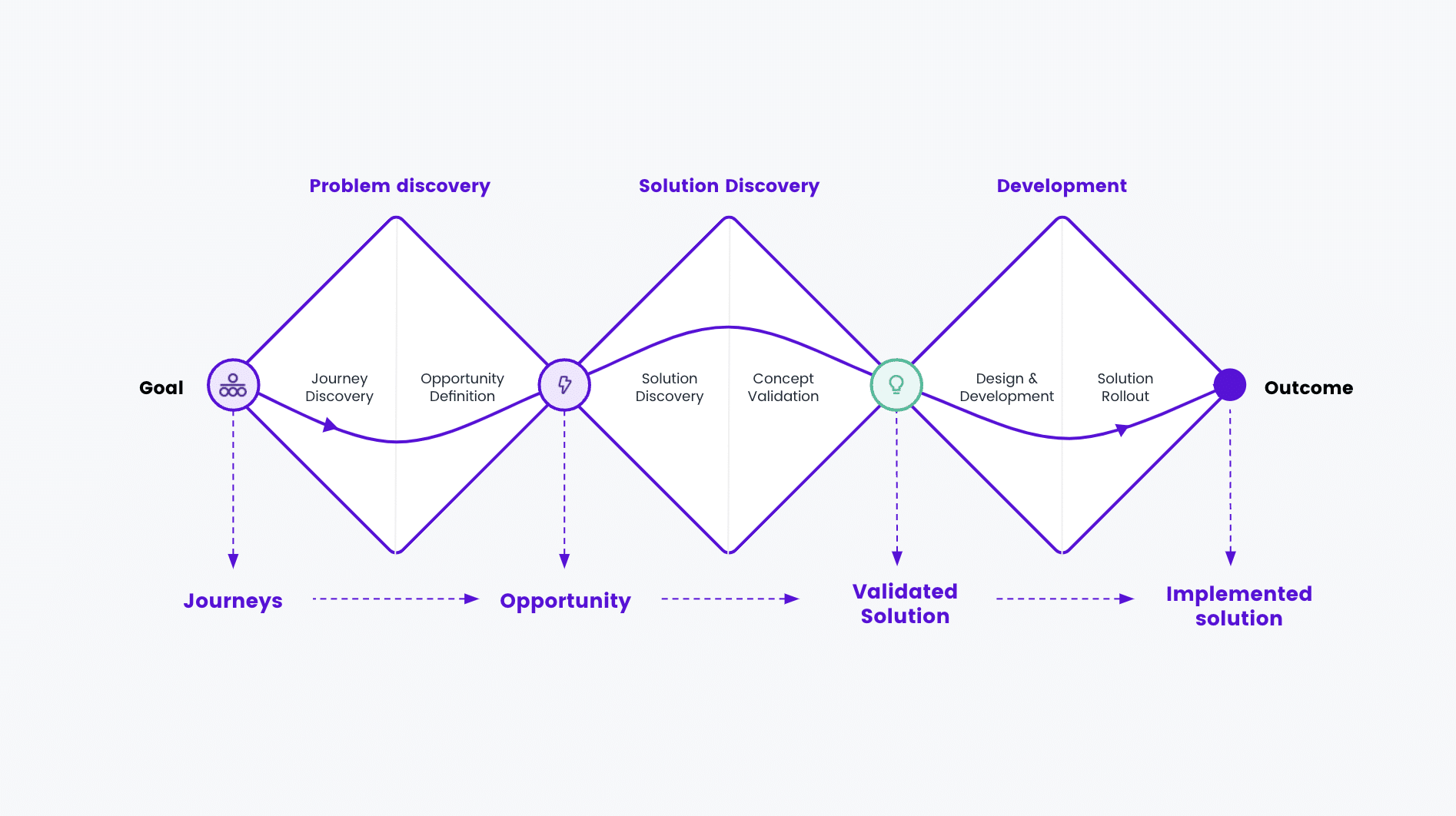
(I am a big believer that the triple diamond model is more comprehensive than the double diamond.)
Data gathered from user interviews is essential for creating user needs statements, personas, and user journey maps. User interviews are crucial to truly understanding users’ motivations and as such, they are irreplaceable in the design process. A product made without understanding its users can never be considered truly user-centric.
What are the types of user interviews?
Before choosing the right type of user interview, take a moment to revisit your goals and think about the kind of insights you’re hoping to gather
1. Structured Interviews
Structured interviews are meticulously planned and conducted in a systematic manner as the process is standardized and easily replicable. They’re perfect for when you need to gather specific information but they do require a good level of organization to stay on track.
2. Unstructured Interviews
These are much more flexible and allow participants to share their thoughts openly. Unstructured interviews are great for uncovering deeper insights, motivations, and perspectives that might not come up otherwise. Just one thing to remember: unstructured does not mean impromptu!
3. Semi-Structured Interviews
Why not get the best of both worlds? 😉 Semi-structured interviews combine prepared questions with the freedom to explore new topics as they surface.
4. Contextual Interviews
These happen in the user’s natural environment, providing valuable insights into how they actually interact with a product. The researcher observes the participants in action and then follows up with detailed questions.
This might remind you of usability tests: the difference here is that answers are not probed immediately.
5. Expert Interviews
Expert interviews involve talking to people with specialized knowledge or experience that relates to the design context. Their insights add a wider level of understanding, refining the research and often helping to shape the process.
6. Stakeholder Interviews
Rather than talking to end users, these focus on people with an interest in the development of the product or on decision-makers (internal or external stakeholders). While they potentially help to build a bridge between design goals and organizational goals, keep in mind that usually these stakeholders ≠ users!
7. Group Interviews
These are exactly what the name implies, involving around 5 participants at once. The group dynamic often leads to deeper discussions with people building on each other’s responses. This approach is great for uncovering shared experiences and understanding different perspectives. They are similar to focus groups but not entirely identical — there is still more emphasis on individual responses rather than organic group interactions.

How to conduct user interviews?
For many new designers, the trickiest part of conducting user interviews is the interview itself. It’s easy to feel nervous, unsure of your abilities, or worried that you’re not steering the conversation effectively. Sometimes you might find yourself unintentionally fishing for specific answers, which can lead to biased results.
But here’s a comforting reminder: at the end of the day, it’s just a conversation!
DOs
- Do prepare.
- Clearly define your research goals.
- Write down open-ended questions to guide the conversation (you may also want to prepare an interview guide).
- Test or cross-check your questions beforehand to ensure they’ll help gather the insights you need.
- Do build rapport.
- Start with small talk or warm-up questions to make the user feel at ease.
- Do establish your role as a researcher/designer/expert.
- Explain the purpose of the conversation.
- Let them know how long the interview will take.
- Ask for their consent to record the session.
- Do ask open-ended questions.
- Do listen actively.

DON’Ts
- Don’t ask leading questions.
- Don’t overload the participant with information.
- Don’t dominate the conversation.
- Don’t ignore contradictions.
- Don’t skip post-interview reflection.
What are some common limitations of user interviews?
People tend to forget things because human memory is not perfect. Some answers might thus be vague or inaccurate. Try asking follow-up questions. Participants don’t know what the interviewer considers relevant, so they might withhold some details. Similarly, biases or assumptions might prevent information from being shared. To alleviate this, other research methods such as usability testing can be implemented.
Finally, the quality of the interview itself matters. If you feel that you are not asking the right questions or you’re not comfortable, try asking someone more senior to pilot an interview with you or to observe the process. Don’t feel discouraged! The more user interviews you lead, the easier it will become.
Conclusion
User interviews are one of the most common research methods that aid researchers and designers in making better products. Using empathy to guide the design process is key to actually answering users’ pain points. Hopefully, after reading through these tips, you will feel more prepared to conduct user interviews in your next project!
For finding participants and running user interviews, check out: User Interviews or Lyssna.
Illustrations by: Marina Green
_________________________________
About the instructor:
Mon (Monkomon) is a multi-hyphenate creative based in Rotterdam (NL). She’s worked with companies of all shapes and sizes, and happily shares her expertise. Serial doodler, avid gamer and relentless puzzler.
Find her on linkedin.com/in/